
Ever wondered if you can hire that brilliant developer from Poland or that amazing designer from India for your UK business?
Here’s the truth: thousands of UK companies are already doing it, and they’re saving 40-60% on costs while accessing world-class talent. But there’s a catch – you need to get the legal side right.
I’ve seen too many UK business owners get excited about global hiring, only to panic when they realize they don’t know the legal requirements. Some end up paying hefty fines, others abandon the idea altogether.
But it doesn’t have to be complicated. Let me break down exactly what you need to know.
The Simple Truth About Hiring International Remote Workers
First, let’s clear up the biggest myth: “It’s too complicated for small businesses.”
That’s simply not true. Yes, there are legal requirements, but they’re manageable when you know what you’re doing. I’ve helped hundreds of UK companies navigate this successfully.
Here’s what actually matters:
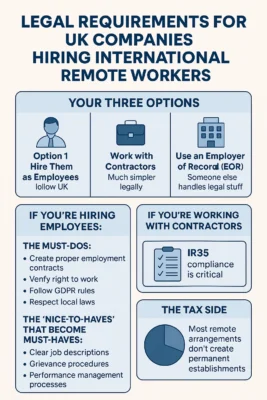
Your Three Options (Choose Wisely)
Option 1: Hire Them as Employees
- They work from their home country
- You follow both UK and their local employment laws
- More paperwork, but full control
- Best for: Long-term, strategic hires
Option 2: Work with Contractors
- Much simpler legally
- They handle their own taxes and compliance
- Less control, but less responsibility
- Best for: Project-based work
Option 3: Use an Employer of Record (EOR)
- Someone else handles all the legal stuff
- You get the talent, they get the headaches
- Costs more, but worth it for peace of mind
- Best for: Companies wanting to move fast
What UK Law Actually Requires (The Real Story)
Let’s cut through the legal jargon and focus on what you actually need to do:
If You’re Hiring Employees
The Must-Dos:
- Create proper employment contracts (in their language if needed)
- Verify their right to work (where applicable)
- Follow GDPR rules for their personal data
- Ensure they’re covered by health and safety policies
- Respect their local employment laws
The “Nice-to-Haves” That Become Must-Haves:
- Clear job descriptions
- Grievance procedures
- Performance management processes
- Data protection agreements
If You’re Working with Contractors
Much simpler:
- Clear service agreements
- Proper invoicing processes
- IR35 compliance (the big one!)
- Basic data protection
The IR35 Reality Check:
This is where many UK companies trip up. If your “contractor” works like an employee (set hours, uses your equipment, takes direction), HMRC might say they’re actually an employee. The penalties can be brutal.
The Tax Side (Don’t Panic, It’s Manageable)
Here’s what most UK companies worry about:
- “Will I create a permanent establishment?”
- “Do I need to register for taxes abroad?”
- “What about double taxation?”
The reality:
- Most remote arrangements don’t create permanent establishments
- You might need local tax registration (but often don’t)
- Double taxation treaties usually protect you
My advice: Get professional tax advice for your specific situation. It’s cheaper than fixing mistakes later
The Step-by-Step Process (From Chaos to Clarity)
Week 1: The Foundation
- Decide your approach (employee, contractor, or EOR)
- Research local requirements for their country
- Draft proper agreements with legal help
- Set up basic compliance systems
Week 2: The Implementation
- Finalize contracts and get them signed
- Set up payroll (if hiring employees)
- Establish communication protocols
- Create performance management systems
Ongoing: The Management
- Monthly payroll and compliance checks
- Quarterly legal reviews
- Annual contract renewals
- Regular performance evaluations
Real-World Examples (What Actually Works)
Sarah’s Success Story (London Tech Startup):
“We hired three developers from Eastern Europe as employees. Yes, we had to set up local payroll, but we’re saving £150K annually compared to London salaries. The legal setup took 3 weeks and cost £5K. Best investment we ever made.”
Mark’s Contractor Approach (Manchester Marketing Agency):
“We work with freelancers from around the world. Keep contracts clear, pay through proper channels, and document everything. Haven’t had a single legal issue in 3 years.”
Lisa’s EOR Solution (Birmingham Manufacturing):
“We needed developers fast and didn’t want legal headaches. Used an EOR service – they handle everything, we just manage the work. Costs 15% more but worth every penny.”
Common Mistakes (Learn from Others’ Pain)
The Big Ones I See Repeatedly:
- Treating contractors like employees – Recipe for IR35 disaster
- Ignoring local employment laws – Expensive lesson waiting to happen
- Poor documentation – Makes everything harder later
- Assuming “remote means no rules” – Laws still apply
- DIY legal compliance – False economy
The Bottom Line
Hiring international remote workers isn’t rocket science, but it’s not something to wing either.
The companies that succeed treat it like any other business process: understand the requirements, set up proper systems, and get professional help where needed.
The ones that struggle? They either overthink it into paralysis or underthink it into legal trouble.
Ready to tap into global talent for your UK business? Start with one hire, get the process right, then scale. Your future self (and your bank account) will thank you.
Get expert guidance on international hiring compliance – book your free consultation with TalentsBridge today.
Your Questions Answered (The Real FAQs)
Q: Can a UK company hire a foreign employee remotely?
A: Absolutely! Thousands do it successfully. The key is choosing the right legal structure. If they’re working from their home country, you’ll need to comply with both UK and local laws. It sounds scary, but it’s routine once you know the process. Most companies either use an EOR service or set up proper local compliance – both work well.
Q: What’s this new flexible working law everyone’s talking about?
A: Since 2024, UK workers can request flexible working (including remote work) from day one – not after 26 weeks like before. You still need good business reasons to refuse, but it’s made remote work more mainstream. Great news if you’re building a remote-first culture.
Q: What legal stuff do I really need to worry about?
A: Focus on the big three: proper contracts (that follow local laws), correct tax setup, and clear employment classification. Get these right and you’re 90% there. Everything else can be handled as you grow. Don’t let perfect be the enemy of good.
Q: Can Americans work remotely for UK companies?
A: Yes, very common arrangement. They stay in the US, you stay compliant with both countries’ rules. Main considerations: are they an employee or contractor, who handles taxes, and how do you manage the time difference. Thousands of UK-US remote arrangements work perfectly.