

As UK businesses enter 2026, one trend is accelerating faster than any other: SMEs are increasingly choosing offshore employees to fill essential roles, cut costs, and compete more effectively. Rising employment expenses, labour shortages, and pressure on profit margins have pushed companies to rethink how they build and scale their teams. Offshore hiring has moved from a “cost-saving hack” to a mainstream strategic advantage.
While large corporations have used offshore talent for years, SMEs and startups are now adopting this model rapidly — not just to reduce costs, but to gain stability, access global skill sets, and expand operations without the financial weight of local hiring.
Here’s why offshore employees are becoming the top hiring choice for UK SMEs in 2026, what’s driving the shift, and how platforms like TalentsBridge are helping businesses fill roles faster and more reliably.
Why UK Companies Are Turning to Offshore Employees
The UK job market has changed dramatically. Hiring locally has become slower, more expensive, and increasingly competitive — especially for SMEs that cannot match enterprise-level salaries or recruitment budgets.
Offshoring solves several problems at once
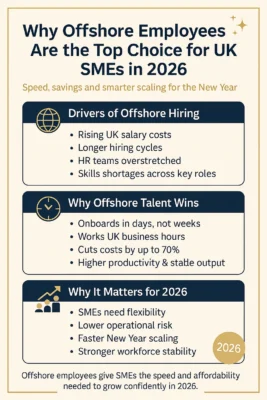
Offshore team members allow businesses to:
- cut salary and overhead costs
- scale teams quickly
- maintain UK-hour support
- access specialised skill sets
- reduce pressure on internal HR
For an SME, these benefits can mean the difference between stagnant growth and a strong year ahead.
Why Companies Choose to Offshore (The Real Reasons)
Many people assume cost savings are the only motivation — but in 2026, the reasons are broader and more strategic.
1. Hiring locally has become too slow
Recruiting in the UK can take weeks or months, especially for admin, customer service, bookkeeping, or IT support roles. Offshore employees can start within days.
2. HR departments no longer have capacity
SMEs have reduced HR staff, meaning they rely on external partners like TalentsBridge to handle recruitment, onboarding, and role management.
3. Skill shortages are growing
UK candidates often lack availability or experience in admin, technical support, finance assistance, and digital operations. Offshore markets offer a stronger, more consistent talent pool.
4. Wage pressure is rising
Higher National Insurance contributions, minimum wage increases, and inflation make local hiring significantly more expensive.
5. Offshore employees improve continuity
UK businesses face holiday absences, seasonal gaps, and turnover spikes — offshore teams ensure reliability and predictable operations all year.
Do 70% of Employers Really Use Social Media to Screen Candidates?
Yes. Over 70% of employers now review social media profiles during the hiring process — LinkedIn, Facebook, Instagram, and even TikTok.
For UK SMEs struggling to hire, this adds:
- more time
- more administrative burden
- more complexity
Offshore staffing simplifies the process because screening, interviews, skill matching, and background checks happen on the provider side.
TalentsBridge removes this entire layer of work.
What Is the Future of Offshoring?
Offshoring in 2026 is no longer just operational support — it is becoming a core strategic growth engine for UK SMEs.
Future trends include:
- more full-time offshore employees replacing local hires
- remote-first teams operating across time zones
- increased outsourcing of admin, finance, IT, and customer service
- UK companies using offshore staff to support scaling, not just cost reduction
Offshoring is evolving into global workforce integration, where remote employees are embedded into a company’s long-term growth plan.
Advantages of Offshore Employees for SMEs
Offshore employees bring benefits that traditional UK hiring simply cannot match.
Cost Efficiency
Offshore employees cost 60–70% less than UK hires — even for full-time roles.
Access to Global Skilled Talent
Companies can hire workers with the exact skill set required — admin, IT, customer service, marketing, accounting, operations.
Scalability
Startups can add staff quickly without needing to expand office space or increase HR workload.
Reduced Operational Risk
Offshore teams ensure continuity during:
- sickness
- holidays
- peak season
- sudden demand spikes
Higher Productivity
Remote offshore workers are often trained for structured, task-focused output.
These advantages make offshore talent the logical next step for any SME focused on growth.
Is Work-From-Home Going Away in 2025?
No — but it is changing.
UK companies are reducing local WFH roles because of cost pressure, inconsistent productivity, and the requirement for hybrid policies. But WFH is not disappearing globally.
Global remote work is increasing sharply because it is:
- cheaper
- more reliable
- easier to scale
- better aligned with business cost structures
Work-from-home isn’t ending — it’s shifting offshore.
What Jobs Pay $3,000 a Month in the UK?
Jobs commonly reaching this level include:
- Customer support specialists
- Bookkeepers
- Operations coordinators
- Social media managers
- IT support assistants
- Administrative supervisors
But hiring these roles in the UK can be expensive.
This is why SMEs increasingly fill them offshore — same skill level, far lower cost.
Why TalentsBridge Is the #1 Offshore Hiring Partner for UK SMEs in 2026
TalentsBridge has become the preferred partner for SMEs needing skilled staff without stretching budgets.
⭐ What UK SMEs love about TalentsBridge:
- Full-time offshore employees for 60–70% less
- Staff who work UK hours
- Strong English communication
- Fast onboarding (roles filled in days)
- Skilled professionals in admin, operations, IT, customer support, and finance
- No HR burden for the UK company
- Predictable monthly billing
TalentsBridge gives SMEs the ability to grow quickly and safely — a critical advantage in 2026’s competitive market. Come and grow your company with us!.
Conclusion: Offshore Talent Is the SME Growth Engine of 2026
Offshore employees are no longer a back-office option — they are a core competitive advantage. UK SMEs that embrace global remote staffing will scale faster, spend less, and outperform competitors locked into costly local hiring models.
In 2026, offshoring isn’t just smart.
It’s essential for survival and growth.
📍 Explore our locations page to see the regions we serve.
📞 Ready to hire now? Contact us now.
FAQs about Why Offshore Employees Are Becoming the Top Hiring Choice for UK SMEs in 2026
Why do companies choose to offshore?
To reduce costs, access skilled global talent, speed up hiring, and improve operational continuity.
Do 70% of employers use social media to screen candidates?
Yes. Around 70% of employers now check social media before hiring, which increases the workload for HR teams.
What is the future of offshoring?
More companies will integrate full-time offshore employees into core operations, especially for admin, tech, customer service, and finance roles.
What are the advantages of offshore employees?
Lower costs, faster hiring, skilled talent, reduced HR load, operational continuity, and scalability.
Is work-from-home going away in 2025?
Local WFH may decrease, but global remote hiring is rapidly increasing.
What jobs pay $3,000 a month in the UK?
Admin, customer support, bookkeeping, operations, social media, and IT roles often reach this pay band.
{ “@context”: “https://schema.org”, “@type”: “FAQPage”, “mainEntity”: [ { “@type”: “Question”, “name”: “Why do companies choose to offshore?”, “acceptedAnswer”: { “@type”: “Answer”, “text”: “Companies offshore to reduce hiring costs, speed up recruitment, access global talent, and maintain operational stability.” } }, { “@type”: “Question”, “name”: “Do 70% of employers use social media to screen candidates?”, “acceptedAnswer”: { “@type”: “Answer”, “text”: “Yes. Around 70% of employers check social media profiles when hiring, which increases the time and effort required for screening.” } }, { “@type”: “Question”, “name”: “What is the future of offshoring?”, “acceptedAnswer”: { “@type”: “Answer”, “text”: “Offshoring will continue to grow as SMEs integrate full-time offshore employees across admin, IT, finance, and customer service operations.” } }, { “@type”: “Question”, “name”: “What are the advantages of offshore companies?”, “acceptedAnswer”: { “@type”: “Answer”, “text”: “Offshore employees allow UK SMEs to cut costs by up to 70%, scale quickly, access skilled talent, reduce HR load, and stabilise operations.” } }, { “@type”: “Question”, “name”: “Is work from home going away in 2025?”, “acceptedAnswer”: { “@type”: “Answer”, “text”: “No. Local WFH may reduce due to costs, but global remote hiring is expanding rapidly.” } }, { “@type”: “Question”, “name”: “What jobs pay $3,000 a month in the UK?”, “acceptedAnswer”: { “@type”: “Answer”, “text”: “Customer service, bookkeeping, operations, IT support, and social media roles often reach this salary level.” } } ] }