

As UK businesses step into 2026, one trend is impossible to ignore: small and medium-sized enterprises are hiring remote staff at record speed. Rising wages, higher tax pressure, and unpredictable operating costs have made traditional recruitment harder for SMEs — but remote teams have become the shortcut that allows growing companies to scale faster, reduce risk, and stay competitive.
This shift is especially visible at the end of the year. As Christmas winds down and New Year planning begins, UK SMEs look for flexible staffing solutions that won’t strain their budgets or delay operations. Remote workers offer exactly that — skilled support, fast onboarding, and significantly lower costs compared to local hires.
Here’s why remote talent is shaping the future of UK business growth, why productivity improves when companies hire globally, and why more founders are choosing platforms like TalentsBridge to build stronger, more efficient teams in 2026.
Why Remote Working Is Helping UK SMEs Grow in 2026
The UK business landscape has changed dramatically over the past few years. SMEs now operate in a climate where agility is more valuable than ever. Remote working allows smaller companies to compete with larger firms without needing huge budgets or large internal teams.
Productivity has increased — not decreased
Despite misconceptions, data shows that remote working often improves productivity. UK employees save time on commuting, face fewer interruptions, and can structure their work more efficiently. For SMEs, this translates into higher output with lower overhead.
Remote staffing removes geographical limits
Traditional hiring forces a company to rely on local talent — often expensive, unavailable, or not specialised enough. Remote staffing opens access to skilled workers around the world who can support UK operations at a fraction of the cost.
SMEs gain flexibility during seasonal fluctuations
The Christmas–New Year period is one of the most unpredictable times for small businesses. Remote teams allow SMEs to add or reduce staff instantly, without long-term commitments or UK-based hiring costs.
How Remote Teams Increase Company Productivity
The benefits extend beyond saving money — productivity improves through structure, focus, and workflow consistency.
1. Reduced commuting = more working hours
Employees who work remotely reclaim travel time and often start work earlier, increasing overall availability.
2. Focused work environments
Remote teams experience fewer office-based distractions, enabling deeper concentration and faster task completion.
3. Better talent-to-role alignment
SMEs can choose workers who are specifically skilled for a task, rather than settling for whoever is available locally.
4. Round-the-clock coverage
Global remote workers enable time-zone flexibility. UK companies can offer extended support hours without overtime.
This is why remote teams now outperform many in-office environments in terms of productivity and output quality.
How Remote Staffing Benefits UK Companies Directly
Cost savings are immediate
With rising wage expectations, higher NI contributions, office expenses, and compliance costs, UK SMEs are facing pressure from every direction.
Remote staffing removes:
- office rent
- equipment expenditure
- recruitment fees
- local wage inflation
- HR administrative load
It’s not just cheaper — it’s easier.
Better operational continuity
Staff absences, seasonal leave, and inconsistent full-time availability no longer disrupt operations. Remote workers ensure that support functions, admin tasks, and customer service continue seamlessly.
Scalable teams for fast-growing SMEs
Remote staffing enables instant scaling — add a worker today, onboard tomorrow, and keep your business running during the busiest parts of the year.
What Is the 60/40 Remote Working Policy?
The 60/40 model refers to companies expecting employees to work 60% remotely and 40% in-office — a hybrid balance that supports flexibility while maintaining some physical collaboration.
In practice, however, many SMEs find hybrid models costly and difficult to manage, which is why they increasingly choose fully remote global staff instead of hybrid local roles.
Why TalentsBridge Is the Top Choice for UK SMEs in 2026
TalentsBridge provides trained, full-time remote workers who help UK businesses grow without absorbing high employment costs. This model is ideal for SMEs entering the New Year with ambitious goals but limited hiring budgets.
How TalentsBridge Helps SMEs Scale Faster
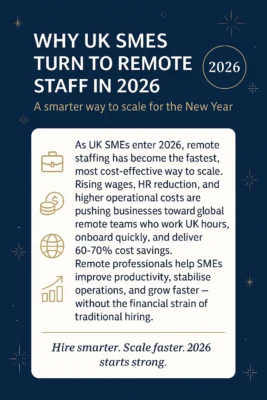
- Remote staff cost 60–70% less than UK-based employees
- Workers are trained to operate on UK hours
- Skilled professionals in admin, IT, customer service, bookkeeping, social media, and operations
- Fast onboarding — roles filled within days
- No HR overhead or recruitment bottlenecks
- Perfect for Christmas-to-New-Year operational gaps
For SMEs seeking stability and growth, TalentsBridge is not just a staffing partner — it’s a competitive advantage for 2026. Want stability and growth in your company too? – Then join us now.
The Future of Hiring for UK SMEs
Remote work is not a temporary trend. As SMEs face rising costs and increased competition, global remote staff will become the backbone of how British companies scale. Whether it’s customer support, admin operations, IT assistance, or back-office tasks, the most successful UK businesses in 2026 will be the ones who hire smarter — not more expensively.
Remote staffing is the shortcut that allows SMEs to grow faster, reduce risks, and protect their bottom line.
📍 Explore our locations page to see the regions we serve.
📞 Ready to hire now? Contact us now.
FAQs about The 2026 SME Hiring Shortcut: How Remote Staff Are Helping UK Businesses Grow Faster
Does working from home increase productivity in the UK?
Yes. Multiple studies show that UK workers are more productive at home due to fewer distractions, reduced commute time, and improved work-life balance.
How does remote working benefit the company?
Remote working reduces overheads, improves productivity, increases talent access, and enables scalable staffing.
How does remote working increase productivity?
Remote workers spend more time focused, experience fewer interruptions, and deliver stronger task-based output.
What is the 60/40 remote working policy?
It’s a hybrid model where employees work 60% remotely and 40% onsite. Many SMEs now prefer fully remote teams due to lower cost and higher efficiency.
{ “@context”: “https://schema.org”, “@type”: “FAQPage”, “mainEntity”: [ { “@type”: “Question”, “name”: “Does working from home increase productivity in UK?”, “acceptedAnswer”: { “@type”: “Answer”, “text”: “Yes. Research shows that UK employees who work from home often report increased productivity due to fewer office distractions and reduced commute time.” } }, { “@type”: “Question”, “name”: “How does remote working benefit the company?”, “acceptedAnswer”: { “@type”: “Answer”, “text”: “Remote working reduces operational costs, improves productivity, increases access to global talent and allows SMEs to scale teams faster.” } }, { “@type”: “Question”, “name”: “How does remote working increase productivity?”, “acceptedAnswer”: { “@type”: “Answer”, “text”: “Remote work increases productivity by enabling focused work time, reducing interruptions, and allowing companies to hire workers with specialised skills.” } }, { “@type”: “Question”, “name”: “What is the 60 40 remote working policy?”, “acceptedAnswer”: { “@type”: “Answer”, “text”: “The 60/40 policy refers to a hybrid model where employees work 60% from home and 40% onsite. Many SMEs now shift to fully remote staffing due to cost savings and efficiency.” } } ] }