

As UK businesses step into the New Year, hiring strategies are shifting fast. Rising employment costs, tighter margins, and increasing pressure on internal teams are forcing startups and SMEs to rethink how they build operational support functions. One role category, in particular, is seeing strong growth in demand: remote admin and accounting staff.
From day-to-day administration to bookkeeping and financial reporting, these functions are essential for business continuity. Yet hiring locally for them has become slower and more expensive. In response, more UK companies are turning to remote professionals who can deliver the same outcomes at a fraction of the cost.
This shift is not a short-term workaround. It’s a structural change in how UK businesses operate, and it’s shaping hiring decisions well into 2026.
Why Remote Admin & Accounting Roles Are Gaining Momentum
Administrative and accounting tasks sit at the core of every business. When these roles are understaffed or delayed, everything from customer response times to cash flow management suffers. Traditionally, UK companies hired these roles locally, often full-time and office-based. That model is now under strain.
Several factors are driving the move to remote staff:
- rising wages and National Insurance costs
- limited availability of qualified candidates
- longer recruitment timelines
- pressure to reduce fixed overheads
- growing acceptance of remote, outcome-based work
Remote admin and accounting staff offer a way to maintain operational standards while keeping costs under control.
What Are the WFH Trends in the UK for 2026?
Work-from-home in the UK is evolving rather than disappearing. While some companies are reducing local WFH roles due to office policies or hybrid mandates, remote work itself is expanding globally.
Key UK trends include:
- a shift from local remote roles to global remote teams
- increased use of offshore professionals for support functions
- greater focus on output and accuracy rather than hours logged
- remote-first processes for admin, finance, and operations
For many SMEs, fully remote admin and accounting roles are easier to manage than hybrid local positions, especially when budgets are tight.
Are Accounting Jobs in Demand in the UK?
Yes — accounting and finance-related roles remain in strong demand. However, the challenge is not demand, but cost and speed.
Local accounting hires often require:
- higher salaries
- longer notice periods
- additional compliance and HR management
- office-based infrastructure
As a result, many companies are choosing remote accounting professionals for tasks such as bookkeeping, reconciliations, payroll preparation, invoicing, and financial reporting. These roles are well suited to remote delivery and can be integrated smoothly into existing systems.
How UK Companies Are Adapting to Remote Work
Adaptation is no longer optional. UK businesses that want to stay competitive are redesigning workflows to support remote delivery.
This includes:
- cloud-based accounting platforms
- digital document management
- structured task tracking and reporting
- clear performance benchmarks
Admin and accounting roles, in particular, benefit from this structure. Tasks are measurable, repeatable, and outcome-driven, making them ideal for remote professionals.
Companies that embrace this model reduce dependency on office-based staff and gain more control over operational costs.
Is Work From Home Going Away in 2025 or 2026?
No — but it is changing form.
Local work-from-home roles may decline in some sectors due to cost pressures and hybrid policies. However, global remote work is growing rapidly, especially for support and back-office functions.
What UK businesses are moving away from:
- expensive local WFH roles
- hybrid setups that still require office costs
What they are adopting instead:
- fully remote global staff
- clear task-based roles
- predictable monthly costs
Remote admin and accounting staff fit this model perfectly.
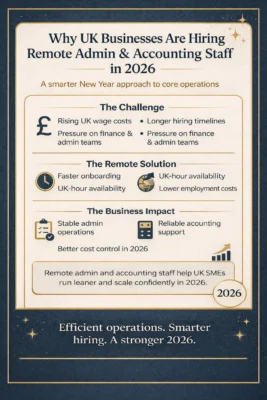
Why Startups and SMEs Prefer Remote Admin & Accounting Staff
For startups and growing businesses, admin and accounting roles are critical but rarely revenue-generating. That makes cost efficiency essential.
Remote staff provide several advantages:
- lower salary expectations compared to UK hires
- faster onboarding
- flexibility to scale up or down
- consistent support during peak periods
- reduced HR and compliance workload
These benefits allow business owners to focus on growth while keeping operational functions running smoothly. Want to know more about us? Click here
Why TalentsBridge Is the Smart Choice for Remote Admin & Accounting Staff
TalentsBridge helps UK businesses hire skilled remote professionals without the complexity of traditional recruitment.
What TalentsBridge offers
- experienced admin and accounting staff trained for UK business needs
- professionals who work UK hours
- support across bookkeeping, invoicing, payroll preparation, reporting, and general admin
- fast onboarding, often within days
- significant cost savings compared to local hiring
- reduced HR burden for business owners
For companies entering the New Year with growth plans but limited hiring budgets, TalentsBridge provides a practical, reliable solution.
Conclusion: A Smarter Way to Hire in 2026
Remote admin and accounting staff are no longer an alternative option. They are becoming the default choice for UK businesses that want to operate efficiently, control costs, and scale with confidence.
As hiring challenges continue into 2026, companies that adopt remote-first support teams will be better positioned to grow, adapt, and compete.
📍 Explore our locations page to see the regions we serve.
📞 Ready to hire now? Contact us now.
❓ FAQs about Remote Admin & Accounting Staff: The New Year Hiring Trend UK Businesses Are Adopting
What are the WFH trends in the UK?
UK businesses are shifting from local remote roles to global remote teams, focusing on cost efficiency and output-based work.
Are accounting jobs in demand in the UK?
Yes. Demand remains strong, but many companies are choosing remote accounting professionals to manage costs and speed up hiring.
How are companies adapting to remote work?
By using cloud systems, digital workflows, and structured task management to support fully remote roles.
Is work from home going away in 2025?
No. Local WFH may decline, but global remote work is expanding, especially for admin and accounting roles.
{ “@context”: “https://schema.org”, “@type”: “FAQPage”, “mainEntity”: [ { “@type”: “Question”, “name”: “What are the WFH trends in the UK?”, “acceptedAnswer”: { “@type”: “Answer”, “text”: “UK companies are shifting from local work-from-home roles to global remote teams, focusing on cost efficiency and outcome-based work.” } }, { “@type”: “Question”, “name”: “Are accounting jobs in demand in the UK?”, “acceptedAnswer”: { “@type”: “Answer”, “text”: “Yes. Accounting roles remain in demand, but many businesses are hiring remote professionals to reduce costs and speed up recruitment.” } }, { “@type”: “Question”, “name”: “How are companies adapting to remote work?”, “acceptedAnswer”: { “@type”: “Answer”, “text”: “Companies are adopting cloud-based tools, digital workflows, and structured reporting to support fully remote teams.” } }, { “@type”: “Question”, “name”: “Is work from home going away in 2025?”, “acceptedAnswer”: { “@type”: “Answer”, “text”: “No. While some local WFH roles may decline, global remote work is expanding rapidly, particularly for admin and accounting functions.” } } ] }