

As 2026 begins, UK companies are entering one of the most competitive hiring periods in recent years. With rising employment costs, skill shortages across multiple sectors, and pressure on businesses to grow with tighter budgets, one solution has emerged as the clear winner: affordable remote workers.
Startups and SMEs are increasingly moving away from traditional recruitment, choosing instead to build global, remote-first teams that deliver strong results at a significantly lower cost. Remote workers help companies scale faster, stabilise operations, and improve productivity without the financial strain of hiring locally.
Here’s why affordable remote workers have become essential for UK business growth — and how companies are leveraging platforms like TalentsBridge to build stronger, more agile teams in 2026.
Why UK Companies Are Shifting Toward Affordable Remote Workers
The UK labour market has tightened, and hiring locally has never been more challenging or expensive. Between rising wages, increased National Insurance contributions, recruitment costs, and a slowdown in skilled talent availability, traditional hiring models no longer make sense for many businesses.
Remote workers solve these challenges immediately.
Cost-efficiency that UK SMEs urgently need
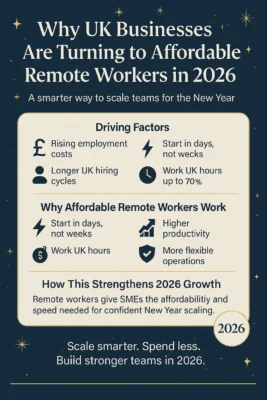
Remote workers allow companies to cut employment costs by 60–70%, even for full-time roles. This makes it possible for SMEs to hire skilled professionals without stretching their budgets.
Faster onboarding compared to UK recruitment
While hiring locally can take weeks or months, remote talent can start within days. For businesses navigating fast growth, product launches, or seasonal spikes, this speed is a game changer.
Access to a broader, more specialised talent pool
Companies are no longer restricted by geography. Affordable remote workers offer skills across admin, customer service, IT, finance, content, technical support, and operations.
Increased flexibility during unpredictable economic periods
Remote workers give companies the ability to scale teams up or down quickly — without long-term commitments or high overheads.
Can UK Companies Hire Foreign Workers Remotely?
Yes — and in 2026, this has become one of the most common hiring models across SMEs, tech startups, and online businesses.
Because these workers are employed remotely and operate outside the UK, companies do not need:
- a UK work visa
- relocation budgets
- office space
- equipment costs
- domestic employment contracts
Platforms like TalentsBridge take care of oversight, HR processes, performance monitoring, and role-matching, making it easy for UK companies to legally and seamlessly hire full-time overseas professionals.
This model gives businesses global capability without UK compliance complexity.
How Remote Work Is Reshaping the Workforce in 2026
Remote work is no longer a perk — it’s a strategic advantage.
1. Businesses are becoming location-independent
Companies can operate smoothly without physical office space, reducing overheads and reinvesting savings into growth.
2. Team structures are changing
Support functions (admin, customer service, finance, operations) are increasingly handled by offshore remote workers.
3. Productivity is rising
Remote talent often works in structured, task-focused environments that deliver high output without office distractions.
4. Hiring cycles are becoming shorter
The traditional HR bottleneck is disappearing as companies rely on external partners for staffing.
Remote work is fundamentally reshaping how businesses build, maintain, and scale their teams.
Is Work-From-Home Coming to an End?
No — but it is evolving.
UK companies are reducing local WFH roles due to cost pressures, inconsistent productivity, and hybrid office expectations. However, global remote work is expanding rapidly.
What’s ending is expensive, UK-based remote work.
What’s growing is affordable global remote staffing.
SMEs want:
- lower salary costs
- stable output
- reliable support
- flexible roles
- workers trained for UK-hour alignment
This shift is pushing more companies toward remote global employees rather than local WFH arrangements.
Which Companies Are Adopting Remote Work Policy Improvements in 2026?
Across the UK, businesses of all sizes are improving or expanding their remote work frameworks.
Top adopters include:
- Tech startups reducing office costs
- E-commerce companies scaling customer support
- Digital agencies needing admin and operations staff
- SMEs struggling with high local employment costs
- Service-based businesses shifting to hybrid global teams
- Early-stage companies building lean, remote-first structures
These companies are prioritising operational flexibility and cost efficiency — two areas where affordable remote workers excel.
Why TalentsBridge Is the Best Partner for Affordable Remote Workers in 2026
TalentsBridge has become the preferred choice for UK SMEs that want to scale teams quickly without compromising quality or burning through budgets.
What TalentsBridge Offers UK Companies
- Full-time remote workers at 60–70% lower cost than UK hires
- Staff trained to work UK business hours
- Skilled professionals across admin, IT, customer service, operations, bookkeeping, and digital support
- Fast onboarding — staff can start within days
- All HR, compliance, and management handled externally
- Predictable monthly pricing with no hidden fees
Why SMEs Choose TalentsBridge
- Reliable workforce stability during growth periods
- Strong English communication
- Higher productivity
- Reduced workload for internal teams
- Perfect solution for startups with small budgets but big goals
TalentsBridge helps UK companies scale faster, spend smarter, and stay competitive in 2026’s demanding market. So don’t waste your time and join us!
Conclusion: Affordable Remote Workers Are the Future of UK Business Growth
The companies that win in 2026 will be the ones that embrace flexibility, global talent, and cost-efficient team-building. Affordable remote workers give SMEs the chance to grow at speed, reduce risks, increase productivity, and maintain stability in a rapidly changing economy.
For UK businesses wanting to scale teams sustainably and intelligently, the solution is clear:
hire remote — hire globally — hire affordably.
📍 Explore our locations page to see the regions we serve.
📞 Ready to hire now? Contact us now.
FAQs about How UK Companies Can Scale Teams in 2026 Using Affordable Remote Workers
Can UK companies hire foreign workers remotely?
Yes. UK companies can legally hire full-time foreign remote workers without visas or relocation requirements.
How is remote work reshaping the workforce?
It is increasing flexibility, reducing costs, expanding talent access, and enabling companies to operate without relying on physical office structures.
Is WFH coming to an end?
Local WFH may decline, but global remote staffing is expanding rapidly as a more cost-effective alternative.
What companies are improving remote work policies?
Tech startups, SMEs, e-commerce brands, digital agencies, and service businesses are leading policy expansion.
{ “@context”: “https://schema.org”, “@type”: “FAQPage”, “mainEntity”: [ { “@type”: “Question”, “name”: “Can UK companies hire foreign workers remotely?”, “acceptedAnswer”: { “@type”: “Answer”, “text”: “Yes, UK companies can hire foreign employees remotely without visas or relocation, as long as work is performed outside the UK.” } }, { “@type”: “Question”, “name”: “How is remote work reshaping the workforce?”, “acceptedAnswer”: { “@type”: “Answer”, “text”: “Remote work is driving structural changes in the workforce by reducing office dependence, increasing talent diversity, lowering operational costs, and enabling faster hiring cycles.” } }, { “@type”: “Question”, “name”: “Is WFH coming to an end?”, “acceptedAnswer”: { “@type”: “Answer”, “text”: “Local WFH roles may decrease, but global remote work is growing rapidly as companies prioritise affordability and scalability.” } }, { “@type”: “Question”, “name”: “What are top companies adopting remote work policy improvements?”, “acceptedAnswer”: { “@type”: “Answer”, “text”: “Tech startups, SMEs, e-commerce firms, digital agencies, and service providers are improving remote work policies to reduce costs and increase workforce flexibility.” } } ] }