

The start of 2026 marks a major shift in how UK companies hire, operate, and manage their teams. With rising labour costs, higher tax pressures, and ongoing economic uncertainty, thousands of businesses — especially startups and SMEs — are rethinking their staffing strategy. Instead of expanding expensive in-office teams, more companies are turning to remote global staff to cut costs quickly, stay competitive, and scale smarter.
This has created a powerful opportunity for job seekers looking to secure a remote role before the New Year — and a turning point for UK founders who want to keep their businesses running without burning through budgets.
Here’s why 2026 is shaping up to be the biggest year yet for remote hiring in the UK, what’s driving this shift, and why companies are choosing platforms like TalentsBridge to fill roles faster and more affordably.
Why UK Companies Are Changing Their Hiring Strategy in 2026
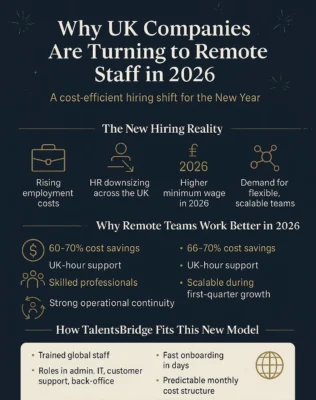
The pressure on businesses has been building over the past few years, but 2026 is the year many companies finally take decisive action. Several factors are pushing employers toward leaner, more flexible staffing models:
1. Rising Employment Costs
National Insurance contributions, inflation-driven wage increases, and higher compliance costs have made traditional hiring significantly more expensive. Many companies simply cannot afford the overheads of a full UK-based team.
2. Minimum Wage Increasing Again
With the UK minimum wage expected to rise in 2026, local hiring becomes even harder for small businesses. Higher wages combined with additional employer obligations push companies to explore global, remote alternatives.
3. A Shift in Business Priorities
Businesses today need agility — fast onboarding, flexible contracts, and low-risk staffing models. Remote workers allow companies to scale up or down without long-term commitments.
4. End-of-Year Burnout and Staff Turnover
Every January brings a surge of resignations and employee burnout. Startups preparing for Q1 growth don’t have time to deal with recruitment delays or training gaps.
Remote global staff fill these gaps instantly, keeping operations smooth even during major transitions.
Why HR Departments Are Shrinking — and What That Means for Remote Hiring
One of the biggest trends entering 2026 is the downsizing of HR teams. Companies aren’t “getting rid of HR” altogether — they’re reducing internal headcount and replacing manual workflows with automation and outsourced staffing solutions.
Why?
- HR processes are expensive
- Compliance work is draining internal resources
- Hiring locally is slow and costly
- Remote staffing partners can handle recruitment faster and cheaper
By reducing HR overhead and shifting to outsourced or global hiring models, companies save both money and time.
This shift directly fuels the growth of remote work.
Are Bosses Really Fed Up With Remote Work?
Not quite — but they are fed up with poor productivity and high local hiring costs.
Many UK companies learned the hard way that managing large, local remote teams is expensive, inconsistent, and difficult. What they aren’t fed up with is remote work itself — they’re fed up with the cost and complexity of hiring in the UK.
This is why more founders are switching to remote global staff who:
- work UK hours
- cost 60–70% less
- are trained for admin, support, IT, operations
- deliver stable, reliable output
So no — WFH isn’t ending.
Local remote hiring is shrinking.
Global remote hiring is exploding.
Why Remote Work Isn’t Coming to an End (But Evolving)
The question “Is WFH coming to an end?” appears everywhere, but the reality is clearer than ever:
- Companies are reducing office space
- Hybrid schedules are becoming the norm
- Startups are hiring globally first, locally second
- Remote-first business models let teams operate 24/7
Remote work in the UK isn’t dying —
it’s transitioning from local to global.
This creates the strongest remote hiring wave entering 2026.
Why UK Startups Are Turning to TalentsBridge for 2026 Hiring
Startups and fast-growing SMEs face a specific challenge: limited budgets, unpredictable workloads, and the need to scale quickly without over-hiring.
TalentsBridge solves all three.
Key Advantages for UK Companies
- Hire skilled full-time remote staff at 60–70% lower cost
- Workers trained in admin, customer service, IT support, bookkeeping, sales operations
- Professionals who work UK hours
- Fast onboarding — new staff start within days
- No need for HR expansion
- No long-term commitments
- Perfect for New Year planning and Q1 scaling
Why Companies Choose TalentsBridge Specifically
- More reliable than freelancers
- More affordable than UK temps
- Higher skill levels than agency contractors
- Seamless communication
- Predictable monthly pricing
- Strong support for startups needing stability
As 2026 begins, companies are prioritising operational efficiency — and TalentsBridge offers exactly the staffing model they need. Do you want help with the staffing model in your company? Then join us now.
A New Year of New Opportunities (For Job Seekers & Companies)
The push toward remote staffing in 2026 isn’t a temporary trend — it’s a long-term shift in how UK businesses function. Companies that adopt flexible, global hiring models will scale faster, spend less, and build more resilient teams.
For job seekers, this creates the perfect opportunity to secure a remote role before the new year and enter 2026 with stable income and a forward-looking career path.
For companies, TalentsBridge provides the simplest, fastest, and most cost-effective way to build a strong remote team.
📍 Explore our locations page to see the regions we serve.
📞 Ready to hire now? Contact us now.
FAQs about New Year Hiring 2026: Why UK Companies Are Turning to Remote Staff to Cut Costs Fast
Why are companies getting rid of HR?
Many companies are reducing HR staff because traditional hiring is expensive and slow. Automation, outsourcing, and global remote staffing offer cheaper and faster alternatives.
What is the minimum wage in the UK in 2026?
While final rates may vary by April 2026, minimum wage is expected to rise again, increasing hiring costs for UK employers.
Why are bosses fed up with remote work?
Bosses aren’t fed up with remote work itself — they’re frustrated with the high cost and low productivity of local remote roles. Global remote staff offer better value and reliability.
Is WFH coming to an end?
No. Remote work is shifting toward global hiring. Companies are downsizing local remote roles but increasing global remote teams due to lower costs and higher flexibility.
{ “@context”: “https://schema.org”, “@type”: “FAQPage”, “mainEntity”: [ { “@type”: “Question”, “name”: “Why are companies getting rid of HR?”, “acceptedAnswer”: { “@type”: “Answer”, “text”: “Companies are reducing HR teams because traditional hiring has become expensive and inefficient. Automation and global remote staffing offer faster and cheaper alternatives.” } }, { “@type”: “Question”, “name”: “What is the minimum wage in the UK in 2026?”, “acceptedAnswer”: { “@type”: “Answer”, “text”: “The UK’s minimum wage is expected to rise again in 2026, increasing labour costs for employers and pushing companies toward more affordable global staffing models.” } }, { “@type”: “Question”, “name”: “Why are bosses fed up with remote work?”, “acceptedAnswer”: { “@type”: “Answer”, “text”: “Bosses are frustrated with the productivity and costs of local remote roles, not remote work itself. Many are switching to global remote workers who offer lower costs and higher reliability.” } }, { “@type”: “Question”, “name”: “Is WFH coming to an end?”, “acceptedAnswer”: { “@type”: “Answer”, “text”: “No. Remote work is evolving. While local remote hiring is slowing, global remote staffing is rapidly increasing as companies prioritise flexibility and cost-efficiency.” } } ] }