

The hiring landscape in the UK has changed dramatically heading into 2026. Companies are growing more cautious with their budgets yet still pushing to expand, innovate, and meet rising customer expectations. But with higher employment costs, tighter labour availability, and increasing pressure on HR teams, filling roles has become slower and more expensive than ever.
Remote staffing has become the shortcut — the strategy thousands of SMEs and startups are leaning on to fill roles faster, strengthen their teams, and reduce operational risk. Remote talent offers affordability, speed, and flexibility at a time when UK businesses need all three to stay competitive.
This guide breaks down why remote staffing is taking over in 2026, why companies are struggling to hire locally, and how platforms like TalentsBridge have become the most reliable way to scale teams without burning through limited budgets.
Why Hiring Has Become More Difficult in the UK
Many UK employers expected recruitment to bounce back post-2024, but the opposite happened. By late 2025, job competition surged, wages climbed, and candidates became harder to attract — especially for roles that require consistency, admin support, customer service, or specialised technical skills.
1. Competition for roles has increased
It’s harder for individuals to get hired — and ironically, harder for companies to find the right fit. Job postings attract more applicants, but fewer with the right availability or skill set.
2. Salaries and overheads are rising
The cost of a single UK employee continues to rise:
- National Insurance
- pension contributions
- paid leave
- equipment
- office space
- rising minimum wage expectations
For SMEs, the financial pressure is significant.
3. HR departments are stretched thin
Longer hiring cycles, more admin, and budget restrictions mean companies simply cannot fill roles as quickly as before.
This mismatch between urgency and affordability is exactly why remote staffing has become essential for 2026.
Why UK Companies Are Turning to Remote Talent in 2026
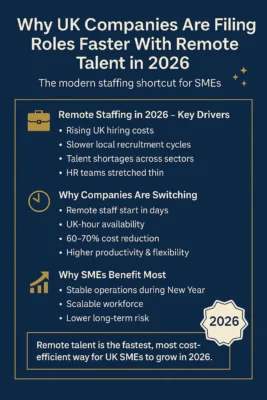
Remote staffing has moved from a “cost-saving tactic” to a core growth strategy. Companies now rely on global remote teams not just to cut costs, but to improve output and scale at speed.
Fast onboarding
While local hiring takes weeks or months, remote talent can start in a matter of days. For startups and SMEs, this speed can determine whether a project succeeds or stalls.
Flexible workforce structure
Instead of committing to long-term, high-cost contracts, companies can grow or reduce teams based on demand. Remote staff adapt to:
- seasonal peaks
- New Year growth cycles
- new product launches
- sudden workload increases
60–70% cost reduction
This is the single strongest driver. Remote workers deliver high-quality output at dramatically lower cost compared to UK-based employees, making them ideal for admin, IT support, customer service, back-office operations, and more.
Access to a wider talent pool
Companies are no longer limited by location. They can hire specialists trained to work UK hours with experience in UK-standard systems.
The Most In-Demand Remote Roles for 2026
Across the UK, companies are rapidly hiring for:
- Customer service and live chat support
- Administrative assistants
- Bookkeeping and finance support
- IT and technical support
- HR coordination
- Email and CRM management
- Social media and content support
These roles are essential to daily operations — which is why hiring delays can be costly. Remote talent fills these gaps instantly.
Is Work-From-Home Going Away in 2026?
Despite headlines claiming “WFH is ending,” the reality is more nuanced.
UK companies are reducing local remote roles due to high costs — not because remote work doesn’t function.
What’s actually happening:
- Local remote roles are shrinking
- Global remote roles are increasing sharply
- Hybrid models remain expensive
- SMEs prefer fully remote global teams over UK-based staff
So no — work-from-home is not going away.
It is shifting toward remote global staffing because it delivers more value.
What Jobs Pay £3,000–£4,000 a Month in the UK?
Roles that commonly reach these income levels include:
- Senior admin positions
- Technical support specialists
- Data analysts
- Bookkeepers and finance managers
- Inside sales and account support roles
However, local hiring for these roles is expensive, pushing SMEs to choose remote alternatives with similar skill levels but lower overhead.
Remote talent allows businesses to access strong capabilities without straining budgets.
Why TalentsBridge Is the Leading Remote Staffing Solution for UK Companies in 2026
TalentsBridge has become the preferred choice for SMEs that need skilled staff quickly, affordably, and reliably.
What makes TalentsBridge stand out?
1. 60–70% lower cost than local hires
Businesses get full-time staff for a fraction of UK salary costs.
2. UK-hour operations
Staff work the same hours as UK teams — essential for SMEs.
3. Faster onboarding than agency recruitment
Roles can be filled within days, not weeks.
4. Skilled workers for core functions
Admin, finance, customer support, IT, marketing, operations — all handled by trained professionals.
5. No HR load for UK businesses
All HR, compliance, and management support is handled on the TalentsBridge side.
6. Ideal for startups preparing for 2026 growth
Companies entering the New Year need strong operations with predictable monthly costs. TalentsBridge gives them stable staffing without financial strain.
With UK companies under pressure to scale without overhiring, TalentsBridge offers the fastest and most cost-efficient path. Want to scale without overhiring ? Then join us now.
The Bottom Line: Remote Staffing Is the 2026 Competitive Advantage
The companies that grow fastest in 2026 will be the ones that hire smarter — not the ones that spend the most. Remote staffing gives SMEs the ability to scale, remain operationally strong, and adapt quickly during uncertain economic periods.
For founders and business owners, the message is clear:
Remote talent isn’t just a solution — it’s the new hiring standard.
📍 Explore our locations page to see the regions we serve.
📞 Ready to hire now? Contact us now.
FAQs about 2026 Guide: How UK Companies Are Filling Roles Faster With Remote Talent
How hard is it to get a job in 2025 in the UK?
Competition increased significantly, making it harder for applicants and slower for companies to fill roles.
What jobs pay $4,000 a month in the UK?
Mid-level admin roles, technical support, operations roles, and finance positions often fall within this range.
Is work from home going away in 2025?
No. Companies are shifting away from local WFH roles but increasing global remote hiring to reduce cost.
What jobs pay $3,000 a month in the UK?
Customer service, admin, bookkeeping, digital operations, sales support, and IT assistant roles often pay within or above this range.
{ “@context”: “https://schema.org”, “@type”: “FAQPage”, “mainEntity”: [ { “@type”: “Question”, “name”: “How hard is it to get a job in 2025 in the UK?”, “acceptedAnswer”: { “@type”: “Answer”, “text”: “Competition increased significantly across the UK labour market in 2025, making it harder for candidates to secure roles and slowing employer hiring cycles.” } }, { “@type”: “Question”, “name”: “What jobs pay $4000 a month in the UK?”, “acceptedAnswer”: { “@type”: “Answer”, “text”: “Roles such as technical support, finance managers, operations specialists, and mid-level admin positions can reach this salary range in the UK.” } }, { “@type”: “Question”, “name”: “Is work from home going away in 2025?”, “acceptedAnswer”: { “@type”: “Answer”, “text”: “No. Companies are shifting away from local WFH roles due to high costs, but global remote hiring is increasing rapidly because it is more affordable and flexible.” } }, { “@type”: “Question”, “name”: “What jobs pay $3000 a month in the UK?”, “acceptedAnswer”: { “@type”: “Answer”, “text”: “Customer service, admin, bookkeeping, technical support, and digital operations roles often pay around $3,000 per month in the UK.” } } ] }