
Looking to hire developers outside the UK? You’re facing a choice that thousands of UK companies are making right now: India or Sri Lanka?
Both countries offer talented developers at competitive rates, but the differences might surprise you. After helping 200+ UK companies navigate this decision, I’ve seen which choice leads to success and which leads to frustration.
Let me break down the real comparison that matters for your business.
The Numbers That Tell the Story
India’s Scale:
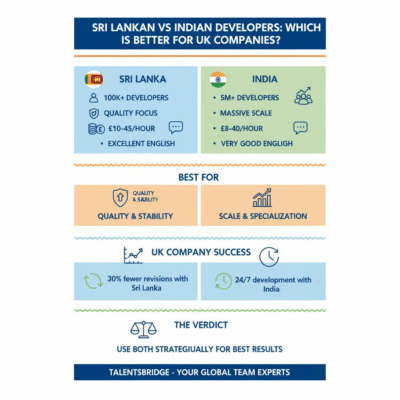
- 5+ million software developers (largest in the world)
- Average salary: £8,000-£15,000 annually
- Time zone: GMT +5:30 (4.5 hours ahead of UK)
- English proficiency: Very high
Sri Lanka’s Focus:
- 100,000+ IT professionals (smaller but growing)
- Average salary: £6,000-£12,000 annually
- Time zone: GMT +5:30 (same as India)
- English proficiency: Excellent (former British colony)
But here’s what the numbers don’t tell you…
Quality vs Quantity: The Real Difference
India: The Volume Play
India’s massive developer pool means you’ll find specialists in every technology. Need a React expert who’s worked on fintech? You’ll find 50. Looking for AI/ML specialists? Hundreds available.
The Good:
- Huge talent pool for any specialization
- Established outsourcing infrastructure
- 24/7 development cycles possible
- Mature project management processes
The Reality Check:
- High competition means constant talent poaching
- Quality varies dramatically between regions
- Communication can be challenging with larger teams
- Cultural differences in work approach
Sri Lanka: The Boutique Approach
Sri Lankan developers focus on quality over quantity. The smaller market means they compete on excellence, not just price.
The Advantages:
- Higher English proficiency on average
- Strong cultural alignment with UK business practices
- Less staff turnover (more stable teams)
- Attention to detail and quality focus
The Limitations:
- Smaller talent pool for niche specializations
- Fewer established outsourcing companies
- Less experience with very large-scale projects
Real UK Company Experiences
Manchester Tech Startup (Chose India):
“We needed 15 developers fast for our fintech platform. India’s scale was perfect. Found great talent, but managing the large team across time zones was challenging. Quality varied between team members.” – Sarah, CTO
Birmingham SaaS Company (Chose Sri Lanka):
“We hired 5 Sri Lankan developers for our core product. Communication was seamless, code quality excellent, and they understood our business requirements intuitively. Like having an extension of our UK team.” – James, Founder
London E-commerce (Tried Both):
“Started with Indian developers for speed, then moved critical components to Sri Lankan team for quality. Now we use both strategically.” – Rachel, Tech Director
Cost Comparison: Beyond Hourly Rates
India Pricing:
- Junior: £8-£15/hour
- Mid-level: £15-£25/hour
- Senior: £25-£40/hour
- Hidden costs: Management overhead, quality control
Sri Lanka Pricing:
- Junior: £10-£18/hour
- Mid-level: £18-£30/hour
- Senior: £30-£45/hour
- Value: Higher quality often means fewer revisions
The Real Cost Calculation:
Sri Lankan developers might cost 10-20% more per hour, but UK companies report 30% fewer revisions and 40% less management overhead.
Technical Capabilities Comparison
India’s Strengths:
- Cutting-edge technology expertise (AI, blockchain, IoT)
- Large-scale enterprise development experience
- Diverse industry knowledge
- Advanced DevOps and cloud capabilities
Sri Lanka’s Strengths:
- Web and mobile development excellence
- Strong software architecture skills
- Quality-focused development practices
- Better understanding of Western business logic
Communication and Cultural Fit
India:
- Direct communication style
- Hierarchical work culture
- May require more detailed specifications
- Different approach to problem-solving
Sri Lanka:
- British-influenced communication style
- Collaborative work approach
- Proactive in suggesting improvements
- Similar business culture to UK
Making the Right Choice for Your UK Company
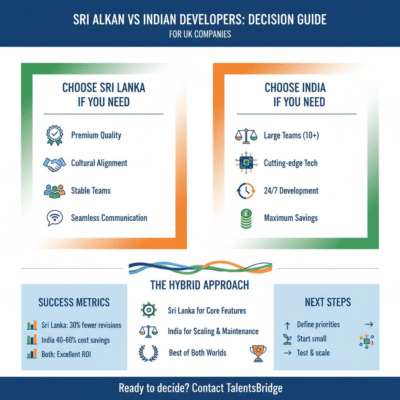
Choose India If You Need:
- Large development teams (10+ developers)
- Cutting-edge technology specialization
- 24/7 development cycles
- Maximum cost savings
- Specific industry expertise
Choose Sri Lanka If You Want:
- High-quality, stable development teams
- Seamless communication
- Cultural alignment with UK practices
- Long-term partnership approach
- Premium quality over volume
The Hybrid Approach
Many successful UK companies use both:
- Sri Lanka for core product development and critical features
- India for scaling, maintenance, and specialized components
This gives you quality where it matters most and scale when you need it.
Your Next Steps
- Define your priorities: Quality vs quantity, communication vs cost
- Start small: Test with 1-2 developers before scaling
- Use specialized platforms: Don’t rely on generic freelance sites
- Plan for management: Budget for proper oversight regardless of choice
The best choice isn’t about which country is “better” – it’s about which fits your specific needs, timeline, and working style.
Ready to find the perfect development team for your UK company? TalentsBridge specializes in connecting UK businesses with pre-vetted developers from both India and Sri Lanka, ensuring you get the right fit for your specific needs.
FAQs on Sri Lankan vs Indian Developers: Which is Better for UK Companies?
Q: Which country has the best developers?
A: Both countries have excellent developers, but it depends on your needs. India offers the largest talent pool with specialists in every technology, while Sri Lanka focuses on quality and cultural alignment. China and Russia often rank highest in coding competitions, but India and Sri Lanka offer better English communication and time zone compatibility for UK companies.
Q: Which country is no. 1 in software engineering?
A: The United States leads in software engineering opportunities and salaries, followed by countries like Canada, Germany, and the UK. However, for outsourcing purposes, India dominates with over 5 million developers, while Sri Lanka is emerging as a quality-focused alternative with excellent English proficiency and cultural fit for UK companies.
Q: How to hire software engineers from India?
A: Start by outlining your development goals, research established outsourcing companies, evaluate options based on technical expertise and cultural fit, begin with a small pilot project, and monitor progress closely. Use platforms that specialize in Indian talent, conduct thorough technical interviews, and establish clear communication protocols from day one.
Q: Are Sri Lankan developers better than Indian developers for UK companies?
A: It depends on your specific needs. Sri Lankan developers often provide better cultural alignment, higher English proficiency, and more stable long-term partnerships. Indian developers offer greater specialization options, larger talent pools, and more experience with enterprise-scale projects. Many UK companies find success using both strategically.